The Future of Smart Contract Wallets
Ethereum co-founder Vitalik Buterin has released a new roadmap titled “The Three Major Transformations,” which lays out the developments he expects to happen to the world’s top smart contract platform in the coming years.
The identified transformations include the layer-two (L2) scaling transformation, where everyone will move to rolups, the wallet security transformation, where everyone will move to smart contract wallets, and the privacy transformation, where developers ensure that “privacy-preserving fund transfers are available” and that other services being developed (such as social recovery) are also privacy-preserving.
According to Vitalik, first, without the L2 scalability transformation, Ethereum will fail, as the cost per transaction will be $3.75 ($82.48 if there is another bull run), and every product targeting the mass market will inevitably forget about the chain and adopt a centralized solution.
Second, without wallet security, Ethereum will fail, “because users will not be willing to store their funds (and non-financial assets),” he noted, which would force users to keep their funds on centralized exchanges, an increasingly dangerous practice given the current regulatory environment in the United States. Without privacy, Ethereum would fail because making all transactions public for anyone to see would be too high a sacrifice of privacy for many users, so everyone would turn to centralized solutions that could at least hide their data.
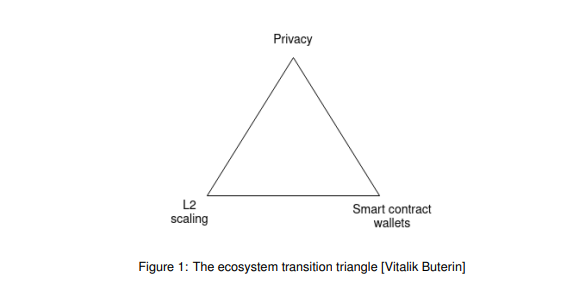
Better-Pro's vision for technology aligns with Vitalik Buterin's vision. Our goal is to build a scalable trading platform that supports smart contract wallets and guarantees user privacy.
For these reasons, Better-Pro is betting on the success of Smart Wallet and zkSync technology, a game-changing Layer 2 scaling solution.
We believe that zkSync and Smart Wallet will become part of mass adoption in the coming months. Holdstation Wallet has taken a big step towards the future of decentralized finance by integrating zkSync.
This integration will provide a smoother, faster, and more secure user experience, while also opening up new possibilities for account abstraction and token trading.
Why did we choose smart contracts as the direction of development?
In short, a smart contract wallet is a wallet mainly used on Ethereum, which is implemented through account abstraction (AA). This AA standard allows wallets to rely on contract accounts (CA) instead of externally owned accounts (EOA). It provides enhanced security, usability, and interoperability for Ethereum users. Instead of controlling the wallet with private keys, users control the smart contract that holds the funds. Smart contract wallets provide recovery without seed phrases, transfer limits, account freezing, and multi-signature (multisig) transactions. These features make smart contract wallets more secure, user-friendly, and interoperable than ordinary wallets.
It is no exaggeration to say that smart wallets will be a game changer for Web3.
But before understanding why, let's take a deeper look at the technical aspects of smart wallets.
Externally Owned Account (EOA): EOA is generated using external wallet software (such as Mleta.Mask) and is managed by a pair of cryptographic public and private keys. Therefore, the account owner in the EOA is responsible for storing the seed phrase offline and protecting it from potential hackers. At the same time, they must ensure that they do not lose their private keys.
EOA is limited to performing basic operations, such as initiating transactions (sending and receiving cryptocurrency) and paying gas fees for EVM execution.
Contract Account (CA): CA is deployed as a smart contract and is controlled by code rather than logic written in private keys. Therefore, it is programmable and can execute arbitrary logic based on the code stored at the address.
However, CA cannot exist independently of EOA, nor can it initiate transactions like EOA. Wallet users must maintain a sufficient balance of funds in their EOA so that the underlying smart contract can execute transactions.
Account Abstraction (AA), or ERC-4337. Unlike CA, which relies on EOA, AA allows the creation of independent custom smart contracts that can seamlessly initiate and execute transactions without EOA. Contract accounts abstract some of the details of interacting with the blockchain when implemented. From a user perspective, "account abstraction" means that some of the technical details of interacting with Ethereum accounts are hidden behind a higher-level interface. This improves wallet design and significantly reduces the complexity of using web3 applications.
Smart Wallets are considered a combination of a contract account (on-chain wallet) and an EOA (off-chain wallet via account abstraction), providing users with many practical features, including the following: Multi-signature authentication. This is similar to an EOA, where multiple parties are responsible for controlling a single account. However, it is better because it simplifies the account recovery process in case any party loses access to the account. Transaction bundling. ERC-4337 allows various transactions to be bundled into a single user action so that they can be quickly verified and executed at the network level.
Let's say you want to interact with multiple dApps using your wallet account. Using the AA feature, instead of launching a separate transaction for each interaction, you can bundle all transactions into a single action and get instant approval.